
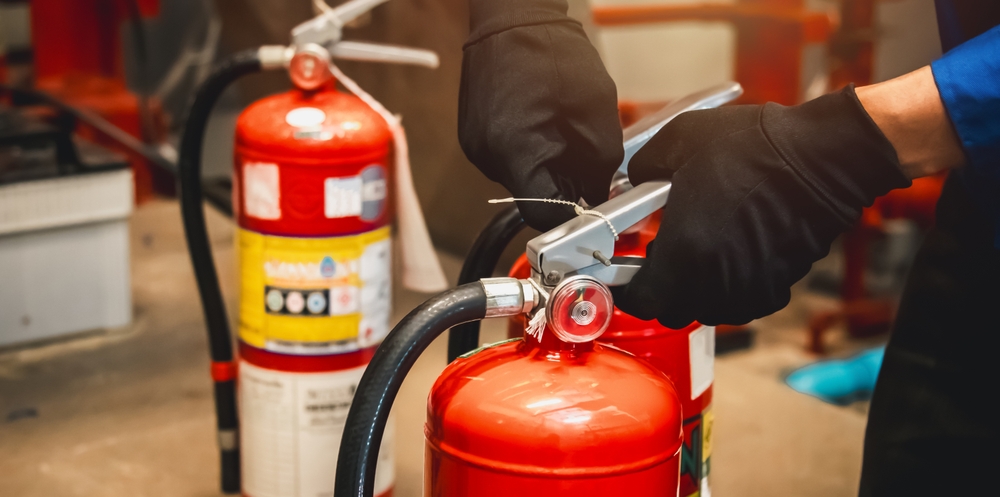
For a business in Dalton, fire extinguishers are more than equipment hanging on the wall. Their type, location, accessibility, inspection schedule, and maintenance can all affect whether a commercial property meets applicable fire-safety requirements.
That matters across local offices, retail spaces, restaurants, warehouses, manufacturing facilities, and other commercial properties throughout Whitfield County.
Quick answer: Commercial properties in Dalton generally need approved portable fire extinguishers selected and installed for the fire hazards present in the building. Georgia fire-safety rules require applicable portable extinguishers to follow NFPA 10 standards for selection, distribution, installation, and maintenance. Businesses also need to consider OSHA workplace rules, including accessibility, monthly visual inspections, annual maintenance, and employee training when extinguishers are provided for employee use.
What Dalton business owners should know
-
Fire extinguishers must be appropriate for the types of fires that could reasonably occur in each area of the property.
-
Georgia currently uses NFPA 10, 2022 Edition, with state-specific modifications governing portable fire extinguishers.
-
Dalton workplaces covered by OSHA generally need extinguishers to remain readily accessible, properly charged, and in their designated locations.
-
Monthly visual inspections and annual maintenance are important parts of ongoing extinguisher compliance.
-
Restaurants, industrial properties, warehouses, and other higher-hazard operations may need different extinguisher types or placement than a standard office or retail space.
What Are the Commercial Fire Extinguisher Requirements in Dalton, GA?
Commercial fire extinguisher requirements in Dalton generally require businesses to provide the correct type and number of approved extinguishers, locate them within acceptable travel distances, keep them accessible, and maintain them according to applicable Georgia fire codes, NFPA 10, and workplace safety requirements.
Georgia’s State Minimum Fire Safety Standards state that portable fire extinguishers must be installed where required by the code. Their selection, distribution, installation, and maintenance must comply with NFPA 10 as adopted by the state.
For employers, OSHA also requires approved extinguishers to be mounted, located, and identified so employees can reach them without unnecessary exposure to injury. Extinguishers must remain fully charged, operable, and in their designated locations.
For Dalton businesses, the exact requirements depend on the occupancy and hazards inside the building. A downtown office has different fire risks from a commercial kitchen, auto service operation, warehouse, or manufacturing facility.
Why Do Fire Extinguisher Requirements Matter for Dalton Businesses?
Fire extinguisher requirements matter for Dalton businesses because different commercial spaces can contain dramatically different fire hazards, and an extinguisher that is appropriate in an office may be inadequate for a kitchen, warehouse, electrical area, or industrial operation.
Dalton and the surrounding Whitfield County area include a mix of commercial buildings, distribution properties, restaurants, retail locations, and industrial facilities. Businesses along the I-75 corridor may have large storage or production areas, while properties around Downtown Dalton and Walnut Avenue may occupy smaller retail, restaurant, and office spaces.
These differences affect extinguisher selection and placement. A professional assessment should consider the building layout, occupancy classification, combustible materials, electrical equipment, cooking operations, flammable liquids, and any special hazards.
At Carpet Capital Fire Protection Inc., we help local businesses evaluate portable fire extinguisher needs and keep equipment properly serviced. Our goal is to help property owners and managers understand what their specific building requires rather than relying on a one-size-fits-all approach.
What Types of Fire Extinguishers Do Commercial Buildings Need?
Commercial buildings need fire extinguishers matched to the classes of fire hazards present, which may include Class A, B, C, D, or K hazards depending on the business and the materials, equipment, and operations inside the property.
Common extinguisher classifications include:
-
Class A: Ordinary combustibles such as paper, cardboard, wood, and some plastics.
-
Class B: Flammable liquids and similar hazards.
-
Class C: Fires involving energized electrical equipment.
-
Class D: Certain combustible metals found in specialized industrial environments.
-
Class K: Commercial cooking fires involving cooking oils and fats.
Multipurpose ABC extinguishers are common in many offices, retail stores, warehouses, and similar commercial spaces, but they are not appropriate for every hazard.
Commercial kitchens require particular attention. Georgia rules specify that portable extinguishers for commercial cooking areas must comply with NFPA 10 and NFPA 96. Class K extinguishers are specifically required for applicable commercial cooking hazards.
A restaurant near Downtown Dalton, for example, may need a Class K extinguisher in addition to extinguishers serving dining, storage, office, and electrical areas.
How Far Apart Should Commercial Fire Extinguishers Be?
Commercial fire extinguisher spacing depends on the fire classification and hazard level, but OSHA requires employees to have access to a Class A extinguisher within a travel distance of no more than 75 feet and a Class B extinguisher within no more than 50 feet when those rules apply.
Travel distance is not simply the straight-line distance between two extinguishers. It considers the route a person would actually have to travel through the building.
Walls, equipment, shelving, locked doors, warehouse racks, and production areas can therefore affect placement.
This is particularly relevant for larger Dalton warehouses and industrial facilities where an extinguisher may appear physically close but require a much longer walking route to reach.
Extinguishers also must remain readily accessible. Placing inventory, furniture, pallets, displays, or equipment in front of an extinguisher can create a problem even if the extinguisher itself is correctly spaced.
How High Should a Fire Extinguisher Be Mounted in Georgia?
Georgia requires portable extinguishers weighing no more than 40 pounds to be installed so the top of the extinguisher is no more than 48 inches above the floor, according to the state’s modification to NFPA 10, while other installation requirements may apply depending on the extinguisher and location.
This is an important Georgia-specific detail because businesses should not assume that a mounting configuration seen elsewhere automatically complies locally.
Extinguishers should also be visible and accessible. Cabinets, wall recesses, signage, and surrounding equipment should be evaluated so employees can identify and reach the extinguisher quickly.
For a Dalton business renovating a storefront, adding warehouse racks, rearranging production equipment, or changing its floor plan, existing extinguisher locations should be reviewed rather than simply left where they were.
How Often Do Commercial Fire Extinguishers Need to Be Inspected?
Commercial fire extinguishers generally need a visual inspection every month and an annual maintenance examination, with additional internal maintenance and hydrostatic testing required at longer intervals depending on the extinguisher type and applicable standards.
OSHA requires workplace extinguishers to be visually inspected monthly and subjected to an annual maintenance check. Georgia also regulates businesses and technicians that perform extinguisher maintenance, recharging, servicing, and testing.
A monthly visual check should look for issues such as:
-
The extinguisher is missing from its designated location.
-
Access is blocked by inventory, furniture, or equipment.
-
The pressure gauge does not indicate the proper operating range.
-
The safety pin or tamper seal is missing or damaged.
-
The extinguisher shows corrosion, leakage, dents, or physical damage.
-
Operating instructions are damaged or difficult to read.
-
The extinguisher appears to have been discharged.
These checks can be especially important in busy Dalton warehouses, restaurants, shops, and production facilities where equipment and inventory move frequently.
What Are the Most Common Fire Extinguisher Compliance Problems?
The most common commercial fire extinguisher problems are blocked access, expired or missing service records, improper extinguisher selection, incorrect placement, damaged equipment, and changes to a building that leave previously acceptable coverage inadequate.
Mistake: Blocking an extinguisher with merchandise or equipment.
Consequence: Employees may not be able to reach it during an emergency.
Better approach: Include extinguisher clearance in routine workplace inspections.
Mistake: Assuming one extinguisher type works everywhere.
Consequence: The extinguisher may not be suitable for the actual hazard.
Better approach: Match extinguisher classifications to each area’s fire risks.
Mistake: Forgetting annual maintenance.
Consequence: An extinguisher may appear normal while still requiring professional service.
Better approach: Track annual service dates for every unit.
Mistake: Moving walls, shelving, or equipment without reviewing extinguisher placement.
Consequence: Travel distances and accessibility can change.
Better approach: Reevaluate protection whenever the floor plan changes.
When Should a Dalton Business Call a Fire Protection Professional?
A Dalton business should call a fire protection professional when an extinguisher needs annual maintenance, recharging, repair, hydrostatic testing, replacement, or when the property layout, occupancy, fire hazards, or equipment has changed enough to affect extinguisher selection or placement.
Business owners and employees can perform routine visual observations, such as confirming that an extinguisher is present, unobstructed, visibly undamaged, and showing an appropriate pressure indication.
Professional servicing is different.
Georgia requires persons performing extinguisher maintenance and recharging to be licensed or permitted under applicable state requirements. Businesses should not attempt to open, recharge, repair, or pressure-test extinguishers themselves.
Professional review is also worthwhile when opening a new location, remodeling an existing space, changing operations, adding commercial cooking equipment, expanding storage, or reorganizing a warehouse.
What Can Businesses Do to Keep Fire Extinguishers Ready?
Businesses can keep fire extinguishers ready by checking them monthly, protecting access around each unit, tracking annual service, replacing or servicing damaged equipment promptly, and reviewing coverage whenever operations or building layouts change.
A practical maintenance routine includes assigning responsibility for monthly checks and keeping the area around each extinguisher clear.
In properties with frequent inventory movement, such as warehouses near the I-75 business corridor, extinguisher access should be part of regular housekeeping procedures. Restaurants should pay particular attention to kitchen hazards and Class K protection. Offices and retail businesses should watch for furniture or displays gradually blocking equipment.
OSHA also requires employers that provide extinguishers for employee use to provide education covering the general principles of extinguisher use and the hazards of fighting an incipient-stage fire.
Employees should understand that a portable extinguisher is intended for a small, developing fire when conditions are safe. Evacuation remains the correct response when a fire is spreading, producing dangerous smoke, blocking an exit, or otherwise creating unsafe conditions.
What Results Should Businesses Expect From Professional Extinguisher Service?
Professional extinguisher service should help identify whether each unit is properly located, suitable for its intended hazard, physically serviceable, and due for maintenance, recharge, testing, or replacement based on the applicable requirements.
Service does not eliminate fire risk. It helps keep portable extinguishers in appropriate operating condition as part of a larger fire protection and emergency planning strategy.
For Dalton property managers with multiple suites, warehouses, or commercial locations, consistent inspection and service records can also make it easier to track individual extinguishers and upcoming maintenance needs.
Common Local Scenario: A Dalton Warehouse Changes Its Layout
A common Dalton scenario is a warehouse that adds racks, production equipment, stored inventory, or partitions without reconsidering its existing fire extinguisher locations, creating longer or obstructed travel paths even though the extinguishers themselves have not moved.
Imagine a Whitfield County facility that originally had open floor space between extinguishers. After additional shelving is installed, employees must walk around several aisles to reach the same equipment.
The old extinguisher positions may no longer provide the same practical accessibility or travel distance.
This is why extinguisher placement should be reviewed after meaningful layout or operational changes rather than only when a unit reaches its annual service date.
Comparing In-House Checks and Professional Fire Extinguisher Service
In-house monthly checks and professional extinguisher service serve different purposes, and businesses generally need both rather than treating one as a substitute for the other.
| In-House Visual Check | Professional Service |
|---|---|
| Confirms the extinguisher is present | Performs required maintenance procedures |
| Checks for obvious damage | Determines serviceability |
| Confirms access is clear | Recharges extinguishers when appropriate |
| Looks at the pressure indicator | Performs required testing and maintenance |
| Can be incorporated into routine facility checks | Must be handled by properly qualified personnel where required |
A good program combines consistent internal monitoring with scheduled professional maintenance.
Service Areas
Our focus for this article is businesses located in Dalton, Georgia, including commercial properties throughout the surrounding Whitfield County area. Businesses outside the primary Dalton market should confirm service availability before scheduling.
What Can Happen If Fire Extinguisher Maintenance Is Ignored?
Ignoring fire extinguisher maintenance can leave a Dalton business with equipment that is blocked, discharged, damaged, improperly selected, or overdue for required service when an emergency occurs.
Compliance concerns are only one part of the issue. A portable extinguisher is intended to provide a usable first response to a small fire when conditions are appropriate. If the equipment cannot be located, reached, or operated as expected, valuable response time may be lost.
Regular inspections also help businesses catch simple problems early, such as a missing seal, low-pressure indication, damaged hose, corrosion, or an extinguisher moved behind stored materials.
Frequently Asked Questions About Commercial Fire Extinguishers in Dalton
Are fire extinguishers required in commercial buildings in Dalton, GA?
Commercial buildings in Dalton can be required to have portable fire extinguishers under Georgia’s State Minimum Fire Safety Standards and other applicable codes. Georgia requires qualifying extinguishers to comply with NFPA 10 for selection, distribution, installation, and maintenance. Exact requirements depend on the property’s occupancy, layout, and fire hazards.
How often should Dalton businesses inspect fire extinguishers?
Dalton workplaces covered by OSHA requirements generally need portable fire extinguishers visually inspected every month and professionally maintained annually. Longer-term maintenance and hydrostatic testing intervals also apply to certain extinguisher types. Businesses should maintain a reliable schedule rather than waiting until an extinguisher appears damaged.
Does every Dalton business need an ABC fire extinguisher?
No. An ABC extinguisher is common in many Dalton offices, stores, and commercial properties, but the correct extinguisher depends on the hazards present. Commercial kitchens, combustible-metal operations, flammable-liquid areas, and other specialized environments may require additional or different extinguisher classifications.
Do Dalton restaurants need Class K fire extinguishers?
Commercial kitchens with applicable cooking hazards generally require Class K portable extinguishers under Georgia fire-safety provisions incorporating NFPA 10 and NFPA 96. Restaurant owners should have the complete kitchen fire protection setup reviewed because portable extinguishers work alongside other required systems and equipment.
Can employees inspect fire extinguishers themselves?
Employees can perform routine monthly visual inspections when properly instructed, checking accessibility, physical condition, pressure indication, pins, seals, and related items. Professional maintenance, recharging, repairing, and certain testing should be performed by qualified personnel. Georgia specifically regulates individuals and companies performing professional extinguisher service.
How close does a fire extinguisher need to be in a workplace?
For OSHA-covered workplaces where extinguishers are provided for employee use, Class A extinguishers generally must be within 75 feet of travel distance and Class B extinguishers within 50 feet, subject to the applicable requirements. Actual placement should also follow NFPA 10 and account for the building’s hazards and layout.
Should extinguishers be reviewed after remodeling a Dalton business?
Yes. Extinguisher placement should be reviewed after remodeling because new walls, shelving, equipment, storage areas, or changes in occupancy can affect accessibility, travel distance, and hazard classification. A layout that worked before a renovation may not provide appropriate coverage after the space changes.
Who can professionally service a fire extinguisher in Georgia?
Professional maintenance and recharging must be performed by persons licensed or permitted as required under Georgia law and the Rules and Regulations of the Safety Fire Commissioner. Businesses should use a qualified fire protection provider rather than attempting to recharge, disassemble, repair, or pressure-test extinguishers internally.
Protect Your Dalton Business With Proper Fire Extinguisher Service
Keeping commercial fire extinguishers accessible, correctly selected, and properly maintained is a practical part of protecting employees, customers, property, and business operations.
We help Dalton-area businesses evaluate and maintain portable fire extinguisher protection based on the needs of the property.