
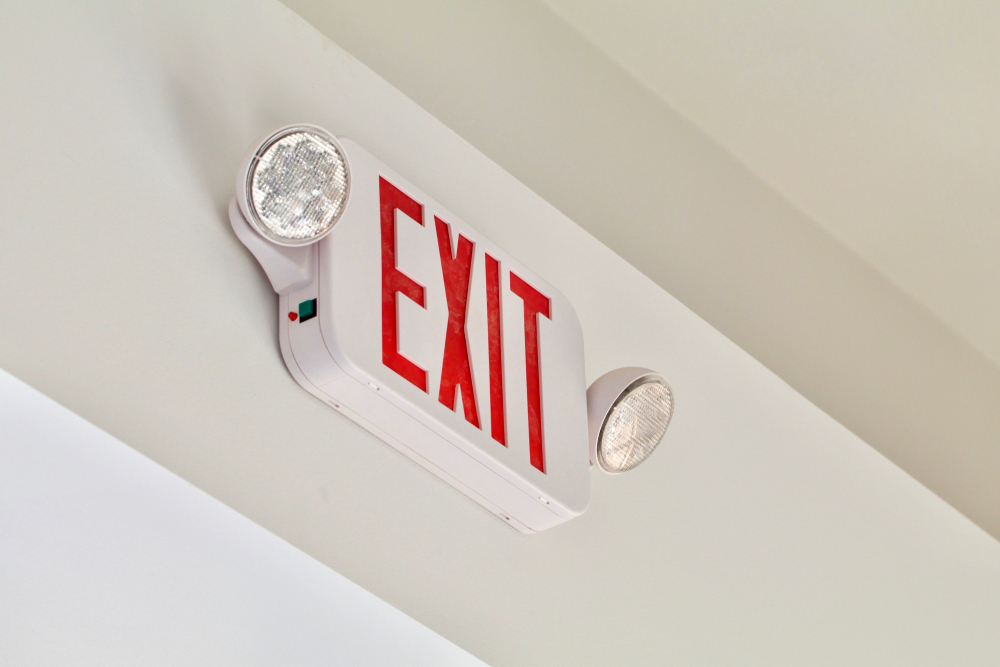
A power outage, fire, or smoke-filled corridor can turn a familiar commercial building into a difficult place to navigate within seconds. For businesses in Dalton, GA, illuminated exit signs and dependable emergency lighting are not simply building accessories. They are part of the life-safety system that helps employees, customers, visitors, and emergency responders move through a building safely.
Quick answer: Commercial properties need properly placed, visible exit signs and emergency lighting that remains functional when normal lighting is interrupted. Georgia fire-safety standards regulate means of egress, illumination, emergency lighting, and exit marking, while the Dalton Fire Marshal’s Office handles local fire and life-safety enforcement. Requirements can differ by occupancy and building layout, so property owners should maintain their systems and address deficiencies before an inspection or emergency.
What local businesses should know
-
Exit signs should clearly identify or direct occupants toward required exits and remain visible along the path of egress.
-
Dalton’s commercial fire pre-inspection materials specifically tell businesses to test emergency lighting and emergency exit lights.
-
Emergency lighting should provide enough illumination for occupants to move safely toward an exit when normal power is lost.
-
Warehouses, offices, retail spaces, restaurants, manufacturing facilities, and other commercial occupancies may have different egress requirements based on their use and layout.
-
Renovations, tenant changes, blocked sightlines, and rearranged storage can create exit-lighting problems even when the original installation was compliant.
Why Fire Exit and Emergency Lighting Matter in Dalton
Fire exit and emergency lighting matter in Dalton because they help keep evacuation routes identifiable and usable when normal visibility or electrical service is disrupted. This is especially important in commercial buildings where employees and visitors may be spread across offices, production areas, storage rooms, corridors, and public spaces.
Dalton and Whitfield County include a wide range of commercial and industrial properties, from Downtown Dalton storefronts and Walnut Avenue businesses to manufacturing and warehouse facilities near major transportation corridors such as Interstate 75.
Large floor plans, interior partitions, tall storage racks, equipment, and changing tenant layouts can all affect whether an exit is easy to identify from occupied areas. A sign that technically works but is obscured by merchandise, shelving, or a newly installed wall may not provide effective direction when people need it most.
Carpet Capital Fire Protection Inc. understands that life-safety equipment has to function as part of the building as a whole. We encourage property managers and business owners to evaluate exit visibility and emergency lighting as part of routine fire-safety maintenance rather than waiting until an inspection identifies a problem.
What Georgia and Dalton Compliance Requirements Mean for Businesses
Georgia and Dalton compliance requirements mean commercial properties must follow applicable state fire-safety standards as enforced by the local authority having jurisdiction. Georgia’s Rules and Regulations for the State Minimum Fire Safety Standards currently adopt the 2024 International Fire Code and the 2024 edition of NFPA 101, Life Safety Code, with Georgia modifications.
The City of Dalton Fire Marshal’s Office states that it enforces Georgia’s State Minimum Fire Safety Standards as well as applicable local fire-protection ordinances. Its responsibilities include inspections of existing buildings, review of proposed construction, fire and life-safety inspections, and approval associated with certificates of occupancy.
For business owners, this means there is no single placement rule that can safely be applied to every property without considering occupancy, building configuration, exit arrangement, and applicable code provisions.
Local Data and Fire Marshal Guidance
Dalton’s own inspection guidance specifically identifies emergency lighting and exit signage as commercial fire-safety inspection items. The Dalton Fire Department’s occupational tax certificate pre-inspection checklist tells businesses to confirm that an appropriate amount of emergency lighting is installed and operational and that exit signs provide visible direction toward exits.
The checklist also instructs businesses to test emergency lights and emergency exit lights before inspection.
That local guidance offers a useful practical lesson. A fixture being mounted on the wall or ceiling is not enough. It has to work, and the overall system has to support a usable route out of the building.
How Emergency Lighting Affects Commercial Safety
Emergency lighting affects commercial safety by illuminating the route occupants need to follow after normal lighting fails. During an outage or fire-related event, stairs, corridor intersections, changes in floor level, doorways, and obstacles can become difficult to see.
This issue can be particularly significant in large Whitfield County facilities with long travel paths or spaces that receive little natural light. An interior warehouse aisle at noon may become nearly dark when overhead electrical lighting fails.
Emergency lighting supports orderly movement instead of forcing employees or customers to rely on phone flashlights, memory, or ambient exterior light.
Warning Signs Your Exit or Emergency Lighting Needs Attention
Exit and emergency lighting should be inspected when there is any sign that a fixture, battery, sign, or evacuation path may not perform as intended. Property managers should watch for:
-
Exit signs that are dark, flickering, damaged, or difficult to see.
-
Emergency light heads that do not illuminate during a test.
-
Fixtures that illuminate briefly but quickly become dim.
-
Exit signs hidden behind displays, shelving, decorations, equipment, or new partitions.
-
Missing directional signs where the route to an exit is not obvious.
-
Damaged housings, loose fixtures, discoloration, or exposed electrical components.
-
Lighting changes caused by renovations or tenant buildouts.
-
Dark areas along the exit path when normal lighting is switched off for testing.
Any of these conditions deserves attention before an actual power failure exposes the problem.
When to Call a Fire Protection Professional
A professional should be called when testing reveals failed equipment, inadequate coverage, questionable exit visibility, damaged components, or uncertainty about code requirements. Staff members can perform basic visual observations, such as noting a damaged sign or confirming that an exit is not blocked, but electrical repairs and compliance evaluations should not be improvised.
For a Dalton commercial property undergoing renovation, changing occupancy, preparing for an inspection, or experiencing repeated lighting failures, professional evaluation can help identify whether the issue involves the fixture itself, backup power, batteries, placement, coverage, or the building’s current egress arrangement.
The local Fire Marshal remains the authority for interpretation and enforcement of applicable fire-safety requirements.
Common Causes of Exit and Emergency Lighting Problems
The most common exit and emergency lighting problems come from aging components, building changes, poor visibility, electrical issues, and missed maintenance. In area commercial properties, several conditions deserve particular attention.
1. Aging backup batteries: Batteries can lose their ability to support emergency fixtures over time, even when a light appears normal during everyday operation.
2. Renovations and tenant changes: New walls, doors, cubicles, shelving, or equipment may alter sightlines and evacuation paths.
3. Warehouse and manufacturing layouts: Tall racks, stored materials, machinery, and production changes can interfere with visibility.
4. Damaged fixtures: Commercial traffic, maintenance work, vibration, moisture, or accidental impacts can damage signs and lighting units.
5. Missed functional testing: A fixture can look fine until normal power is interrupted and its backup components fail.
Businesses around Rocky Face, Tunnel Hill, Varnell, and other Whitfield County communities can encounter the same problems, particularly in buildings that have been modified repeatedly over many years.
Preventing Emergency Lighting Failures
Preventing emergency lighting failures requires routine visual checks, functional testing, clear exit paths, and prompt correction of problems. Businesses should make life-safety lighting part of their regular facility-maintenance process rather than treating it as a once-a-year inspection item.
Walk the normal evacuation routes periodically and look at the building from an occupant’s perspective. Can you identify where to go from work areas, customer areas, storage rooms, and corridors? Are directional signs visible? Do storage changes interfere with fixtures? Does emergency illumination cover the route adequately when tested?
Keep exit routes free from stored materials and avoid hanging decorations or temporary signs where they can obscure exit markings.
DIY maintenance should stop at basic visual and manufacturer-approved operational checks. Electrical repairs, equipment replacement, circuit work, and code-related placement decisions should be handled by qualified personnel.
What to Expect After Professional Service
Professional service should leave the property with identified deficiencies addressed and life-safety lighting operating more reliably for its intended purpose. Depending on the problem, that may involve troubleshooting, battery or fixture replacement, repositioning equipment, correcting damaged components, or recommending additional evaluation.
Property owners should not expect a single repair to eliminate the need for future inspection and testing. Emergency equipment depends on electrical and battery components that can deteriorate over time.
For commercial facilities in Dalton, maintaining accessible records of inspection, testing, or completed repairs can also make facility management easier when preparing for future fire-safety reviews.
Common Mistakes Commercial Property Owners Make
The most common mistakes involve assuming that illuminated signs are automatically compliant, waiting for an inspection to test equipment, and forgetting how building changes affect egress.
Mistake: Only checking whether the EXIT letters are illuminated.
Consequence: The sign may work during normal power but fail when backup operation is needed.
Better approach: Include emergency operation in routine functional checks.
Mistake: Allowing storage or displays to block sightlines.
Consequence: Occupants may not know which direction to travel.
Better approach: Review exit visibility whenever the interior layout changes.
Mistake: Treating emergency lighting as ordinary lighting.
Consequence: A building may appear adequately illuminated until utility power fails.
Better approach: Evaluate the system under the conditions it is designed to address.
Mistake: Waiting until the week of an inspection.
Consequence: Failed batteries or damaged fixtures can become last-minute problems.
Better approach: Include life-safety lighting in ongoing property maintenance.
A Common Dalton Commercial Scenario
A common Dalton scenario occurs when a commercial tenant rearranges its interior without realizing the change affects exit visibility. For example, a warehouse may add taller storage racks, or a retail business may install new displays that interrupt the previous line of sight to an exit sign.
The lights themselves may still operate, but the evacuation route is no longer as obvious from parts of the occupied space.
This is not a case study of a specific Carpet Capital Fire Protection Inc. customer. It is an example of why businesses should reassess life-safety equipment whenever layouts or operations change.
Related Fire Protection Solutions
Exit and emergency lighting work best when they are treated as one part of a broader commercial fire and life-safety program. Depending on the property, related systems may include portable fire extinguishers, fire alarms, sprinkler systems, commercial kitchen suppression equipment, and other required fire-protection components.
Each system performs a different job. Exit signs identify the way out. Emergency lights help occupants see that route. Other fire-protection systems may detect, suppress, or help control a fire.
Comparing Routine Maintenance With Reactive Repairs
Routine maintenance is generally the better approach because it can uncover weak batteries, failed fixtures, and visibility problems before an emergency or inspection.
A reactive approach waits until a unit fails, a power outage reveals a problem, or an inspector identifies a deficiency. That can create avoidable disruption and leave less time to determine the appropriate correction.
A planned approach allows property managers to review equipment alongside other facility maintenance and address changing building conditions as they occur.
Service Areas Around Dalton
Businesses in Dalton and surrounding Whitfield County communities can benefit from keeping exit and emergency lighting on their regular life-safety maintenance checklist. Commercial properties in Rocky Face, Tunnel Hill, Varnell, Cohutta, and nearby Northwest Georgia communities face many of the same concerns involving aging buildings, changing layouts, and active commercial spaces.
The Cost of Ignoring Exit and Emergency Lighting Problems
Ignoring exit and emergency lighting problems can increase evacuation risk, create inspection deficiencies, and leave a business scrambling to make corrections later. The greatest concern is not the fixture itself. It is what happens when employees or customers cannot immediately identify and safely travel toward an exit during a loss of normal lighting.
For busy local businesses, unplanned corrective work can also interrupt operations and complicate inspection or occupancy timelines.
FAQ
Are emergency lights required in commercial buildings in Dalton, GA?
Emergency lighting is required in commercial occupancies when applicable fire and life-safety codes require it for the means of egress. The exact requirement depends on factors such as occupancy classification, building configuration, and exit arrangement. Georgia has adopted NFPA 101 with state modifications, and the Dalton Fire Marshal enforces applicable requirements locally.
Does the Dalton Fire Department inspect exit signs?
Exit signage is included in Dalton’s commercial pre-inspection guidance. The Fire Department checklist tells businesses to verify that an appropriate amount of exit signage is present, that signs provide direction toward exits, that they are visible from applicable areas, and that emergency exit lights are tested.
How do I know whether my emergency lighting is working properly?
A functional check should confirm that emergency fixtures activate as intended when normal lighting power is interrupted and provide useful illumination along the egress route. If a fixture does not activate, becomes unusually dim, has visible damage, or fails to provide adequate coverage, the system should be professionally evaluated.
Can storage racks block an exit sign in a Whitfield County warehouse?
Storage should not interfere with occupants’ ability to identify the required exit route. Because warehouse configurations frequently change, managers should reassess sign visibility after moving or installing racks, inventory, machinery, or partitions. Questions about a specific configuration should be directed to the applicable fire official or qualified professional.
Should a Dalton business test emergency lights before a fire inspection?
Yes, businesses should confirm that emergency lights and illuminated exit signs are operational before an inspection. Dalton’s commercial pre-inspection checklist specifically instructs businesses to test emergency lighting and emergency exit lights. Routine testing also helps discover problems early rather than waiting for an inspector or outage to reveal them.
Do older commercial buildings have to maintain exit and emergency lighting?
Older buildings are still subject to applicable fire and life-safety requirements, although the exact provisions can depend on the building’s approval history, occupancy, alterations, and current conditions. Georgia’s rules include provisions for existing buildings, so owners should not assume that age alone exempts a property from maintaining life-safety systems.
Can I replace a failed emergency light myself?
Basic observation is appropriate, but electrical repair or replacement should be handled according to applicable electrical, fire-safety, and manufacturer requirements. If the problem involves wiring, circuits, fixture placement, backup power, or code interpretation, a Dalton-area business should use qualified professional assistance rather than relying on an improvised repair.
Does changing my floor plan affect exit-lighting requirements?
Yes, floor-plan changes can affect whether occupants can see and follow the required path to an exit. Adding partitions, offices, shelving, displays, or equipment may change sightlines or the arrangement of the means of egress. Life-safety considerations should be reviewed when a commercial space is remodeled or reconfigured.
Protect a Clear Path Out of Your Dalton Business
Reliable emergency lighting and visible exit signs help make a commercial building safer when normal conditions disappear. Keeping these systems operational and addressing problems early can support safer evacuation, smoother facility management, and better inspection readiness.
Contact Carpet Capital Fire Protection Inc. to discuss your commercial fire and life-safety needs.